
Scientists from Singapore Nanyang University of Technology (NTU) have developed a super-fast high-contrast camera that can help self-propelled cars and drones to “see” better under extreme road conditions and in bad weather. Unlike conventional optical cameras, which are "blinded" by bright light, and in the dark they are unable to distinguish details, the new smart camera can record even insignificant movements of an object in real time.
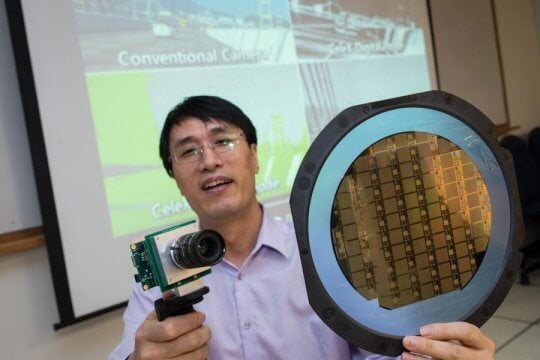
Assistant Professor of Nanyang Technological University (Singapore) Chen Shoushun developed an ultra-fast camera with a unique integrated microchip that allows instant analysis of the scenes, emphasizing important objects and details
The advantages of new development in comparison with existing technologies
The new camera records changes in light intensity between scenes at intervals measured by nanoseconds. It is much faster than regular video. The camera also saves images in a data format, allowing them to be much smaller than usual.
With its unique integrated chip, the camera can instantly analyze the scenes it shoots, highlighting important objects and details.
The camera in question was developed by assistant professor Chen Shoushun from the School of Electrical and Electronic Engineering of Nanyang Technological University. It was called Celex, and its development has now entered its final phase.
According to its developer:
"Our new camera can be a great security tool for self-propelled vehicles, because it can see much better than optical cameras, but without the time lag required for analyzing and processing the video stream."
Developed by scientists, the camera allows you to continuously monitor and instantly analyze the scene. Its task is to help self-propelled vehicles and drones avoid unexpected collisions that usually occur within seconds.
The Celex camera was shown in January of this year at the IS & T International Symposium on Electronic Imaging (EI 2017) symposium in the United States. She received positive feedback from those attending the symposium, many of whom are academics and industry leaders.
How does the new camera work?
The sensor of a conventional camera contains several million pixels that allow you to record information about the light, which is used to form the final image.
High-speed camcorders are capable of recording up to 120 photos per second, thus generating gigabytes of video data that are processed by a computer in order to allow self-propelled transport to “see” and analyze the environment.
The more complex the environment, the slower the processing of video data. The result is a lag between how the camera “saw” something and the action that will be carried out by the self-propelled car as a reaction to what they see.
In order to carry out instant processing of visual data, the patented camera of Nanyang Technological University records the changes between the light intensity of individual pixels of its sensor, which reduces the data output. This avoids the need to capture the entire scene like a photographer and increases the speed of data processing by the camera.
The camera sensor is also equipped with a built-in processor that can instantly analyze data flow, identifying differences between foreground and background objects. This process is also called optical flow calculation. The innovation in question may provide more time for self-propelled vehicles to respond to the approach of the vehicle or obstacles.
Reported additionally, this sensor technology research study began in 2009 and received $ 500,000 in grants. This technology has also been published in two academic journals of the Institute of Electrical and Electronics Engineers (IEEE), which is the world's largest professional organization dedicated to technological progress.
Prospects for the use of technology
Industry has shown interest in this technology. Professor Chen Shoushan and his colleagues formed a startup company Hillhouse Tech, whose task is to commercialize the production technology of the examined cameras. This startup is an incubator for NTUitive, an innovation company at Nanyang University of Technology. Professor Chen Shoushan expects the new camera to be ready for commercial use by the end of this year. Negotiations are underway with global electronics manufacturers.
When, in your opinion, self-propelled transport can become massive and will it happen at all?
Based on sciencedaily.com
The article is based on materials .
Comments
Post a Comment